Introduction
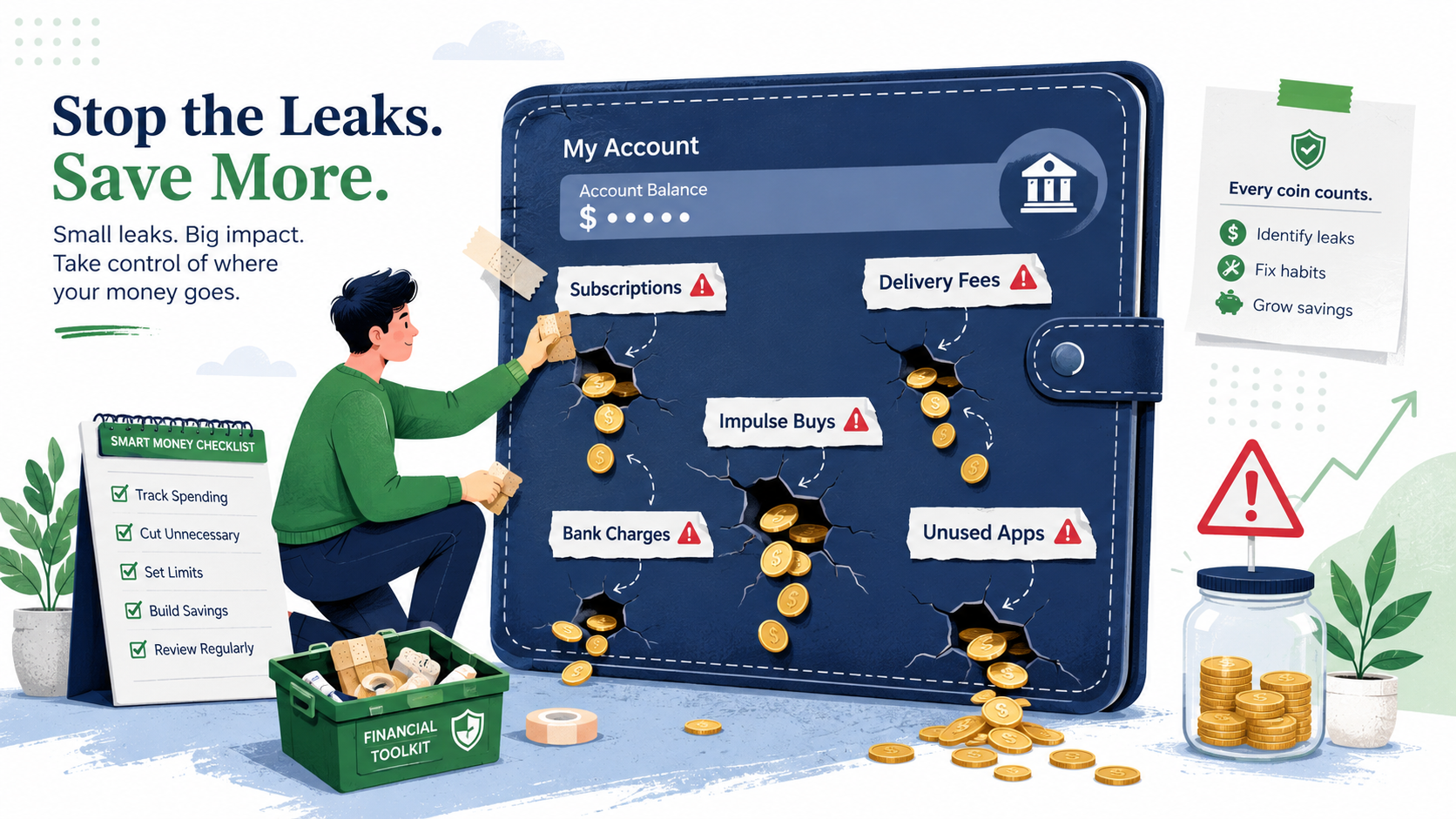
Most people do not lose money in one big mistake.
They lose it slowly.
A subscription here, a delivery fee there, a small upgrade, an unused app, a late payment charge, a random online purchase, a convenience fee, and suddenly the month feels tight.
The dangerous part is that small expenses do not feel serious when they happen. Spending ₹99, ₹199, ₹499, or ₹799 does not feel like a financial problem. But repeated small spending becomes a silent leak.
If your income feels okay but your savings never grow, your problem may not be only income. Your problem may be leakage.
This article explains the common money leaks that quietly drain your monthly budget and how to control them without making life miserable.
1. Unused Subscriptions
Subscriptions are one of the biggest silent money leaks.
Streaming apps, music apps, cloud storage, fitness apps, editing tools, news apps, premium memberships, delivery passes, and learning platforms all look affordable individually.
The problem starts when you forget them.
One ₹299 subscription does not hurt. But five or six subscriptions can silently become ₹1,500 to ₹3,000 every month.
Many people pay for apps they opened only once.
What to do
Open your bank statement and UPI/card history for the last three months. Write down every recurring payment.
Then divide them into three groups:
Use daily
Use sometimes
Forgot completely
Cancel the third group immediately. Pause or downgrade the second group.
A subscription is not cheap if you do not use it.
2. Food Delivery Charges
Food delivery looks simple, but the final amount is often much higher than the food price.
You may pay:
Delivery fee
Platform fee
Packaging fee
Restaurant markup
Small cart fee
Surge fee
Tip
Taxes
A ₹180 meal can easily become ₹280 or more.
The issue is not ordering food once in a while. The issue is using delivery as a default habit whenever you feel lazy, busy, or bored.
What to do
Set a weekly food delivery limit.
For example, allow yourself two orders per week. After that, use simple backup food at home like eggs, dosa batter, curd rice, bread, fruits, frozen chapati, or quick rice meals.
The goal is not to stop convenience. The goal is to stop convenience from becoming your lifestyle.
3. Small Online Shopping Orders
Online shopping platforms are designed to make small purchases feel harmless.
Phone stand, kitchen tool, cable, storage box, cheap gadget, skincare item, home decor, random offer product, and so on.
The problem is not one item. The problem is repeated low-value shopping.
Small purchases are dangerous because you rarely remember them when reviewing your monthly expenses.
What to do
Use the 48-hour rule.
If the item is not urgent, add it to cart and wait 48 hours before buying. Most impulse purchases lose their power after two days.
Also, avoid browsing shopping apps when you are bored. Boredom is expensive.
4. Bank Charges and Penalties
Bank charges feel small, but they are pure waste.
Common examples include:
Late payment fees
Overdraft charges
ATM charges
Minimum balance penalties
Card replacement fees
Cash withdrawal charges
Cheque return charges
Loan payment bounce charges
These charges do not improve your life. They only punish poor tracking.
What to do
Keep a minimum safety buffer in your main account.
Even ₹2,000 to ₹5,000 as a permanent buffer can prevent failed payments, overdraft issues, and unnecessary charges.
Also, turn on SMS or app alerts for low balance, credit card due date, loan EMI date, and automatic debits.
You should never discover a bank charge after it happens.
5. Credit Card Interest
Credit cards are useful only if you pay the full bill on time.
If you pay only the minimum amount due, you are not managing money. You are renting expensive debt.
The minimum payment option is designed to keep you active while interest grows in the background.
What to do
Treat the credit card bill as a full-payment bill, not a minimum-payment bill.
If you cannot pay the full amount this month, stop using the card until the balance is cleared.
A credit card is not extra income. It is borrowed money with consequences.
6. Free Trials That Become Paid Plans
Free trials are not really free if you forget to cancel them.
Many services ask for your card details before the trial starts. After seven days, fourteen days, or one month, the charge begins automatically.
People often do not notice until months later.
What to do
Whenever you start a free trial, immediately set a reminder two days before the trial ends.
Better option: avoid entering card details unless you are already sure you want the paid plan.
A free trial should prove value. It should not trap forgetfulness.
7. Buying Cheap Items That Do Not Last
Cheap does not always mean saving.
Sometimes a low-quality product breaks quickly and forces you to buy again. This happens often with shoes, chargers, cables, kitchen tools, bags, furniture, and electronics accessories.
Buying the cheapest option repeatedly can cost more than buying one decent product.
What to do
For items you use daily, buy for durability, not just price.
Ask this question before buying:
Will I use this often enough that quality matters?
If yes, avoid the cheapest version.
Saving money means reducing total cost, not choosing the lowest price every time.
8. Unplanned Grocery Spending
Grocery stores and supermarkets are designed to make you buy more.
You go for milk and return with snacks, drinks, sauces, cleaning items, offers, and random packaged foods.
Unplanned grocery spending is especially tricky because it feels responsible. You are buying household items, so it does not feel like waste.
What to do
Make a grocery list before going.
Separate it into:
Must buy
Can buy if budget allows
Not needed this week
Never shop when hungry. Hungry shopping increases snack spending.
Also, compare monthly grocery totals, not just individual bills. One bill may look small, but four or five trips can become expensive.
9. Upgrade Traps
Many products are sold with upgrade pressure.
You plan to buy a basic item, but then you see:
Premium version
Extended warranty
Faster delivery
Bigger pack
Combo offer
Add-on accessory
Pro plan
VIP membership
Some upgrades are useful. Most are not.
What to do
Before accepting any upgrade, ask:
Did I need this before seeing the offer?
If the answer is no, skip it.
A discount on something unnecessary is still unnecessary spending.
10. Paying for Convenience Too Often
Convenience is not bad. But frequent convenience spending becomes expensive.
Examples:
Cab instead of public transport
Food delivery instead of simple home food
Paid delivery instead of planned shopping
Quick commerce for non-urgent items
Laundry services for clothes you can wash
Premium delivery for items you do not need urgently
Convenience should solve real problems, not everyday laziness.
What to do
Create two categories:
Worth paying for convenience
Not worth paying for convenience
For example, paying extra during sickness, travel, emergency, or heavy workload may be reasonable. Paying extra because you did not plan basic things is leakage.
11. Not Tracking Cash and UPI Spending
UPI makes spending too easy.
The payment is fast, small, and forgettable. Tea, snacks, petrol, small groceries, parking, tips, mobile recharge, and random transfers all disappear from memory.
Cash has the same problem. Once withdrawn, it often becomes invisible.
What to do
Track small spending for only seven days.
Do not overcomplicate it. Just write down every UPI and cash payment in your notes app.
After one week, you will clearly see where your money is leaking.
You do not need lifetime tracking to fix a problem. Sometimes one honest week is enough.
12. No Separate Savings Account
If your savings stay in the same account as your spending money, you will spend them.
Most people think they will save whatever remains at the end of the month. That usually fails because spending expands to use available money.
What to do
Move savings first.
The day income comes in, transfer a fixed amount to a separate savings account, recurring deposit, or investment account.
Even if the amount is small, the habit matters.
Saving what remains is weak. Spending what remains after saving is stronger.
A Simple Monthly Money Leak Audit
Once a month, do this 20-minute audit:
Check all subscriptions
Review food delivery spending
Check credit card charges
Review UPI small payments
Look for bank fees
Cancel unused services
Compare grocery spending
List impulse purchases
Check upcoming automatic debits
Move savings first
This simple audit can save more money than complicated budgeting apps.
The 24-Hour Spending Filter
Before buying anything non-urgent, use this filter:
Do I need it now?
Will I use it regularly?
Is there a cheaper reliable option?
Am I buying because of emotion?
Will this matter after one week?
Can I delay this purchase by 24 hours?
If the purchase still makes sense after 24 hours, buy it. If not, you just saved money.
Final Thoughts
Saving money is not only about cutting big expenses.
It is about noticing where money quietly escapes.
Small leaks are dangerous because they feel normal. But once you identify them, they are easier to fix than major financial problems.
Start with three actions today:
Cancel one unused subscription.
Review one month of UPI or card spending.
Move a small amount to savings before spending.
You do not need a perfect budget. You need fewer leaks.
Reader Discussion
Comments
Comments are reviewed before appearing publicly.Reader comments